






Today, March 3rd 2010 is IBCLC Day as designated by ILCA-the International Lactation Consultant Association. (IBCLC stands for International Board Certified Lactation Consultant.) This year’s theme is “Experience You Can Trust.” Best for Babes would like to congratulate ILCA on 25 years, and salute the thousands of incredible, dedicated lactation professionals who are helping moms and babies breastfeed every day. While there are still not enough lactation consultants (IBCLCs) per capita in every region, the numbers are growing, as is the awareness of the critical role that IBCLCs play in the mother-baby breastfeeding relationship. Given breastfeeding’s power to reduce the risk of diseases in mother and baby, IBCLCs are truly helping to save two lives for the price of one. If you were fortunate enough to have the help of a great lactation consultant, we hope you will stop right now, and send them a note and thank them. Trust us, they don’t make nearly what they are worth (though we do think health insurance should covered the cost fully, based on reduced lifetime risk of disease and hospital visits). As was beautifully described in the recent New York Times article, lactation consulting is a science and an art, and it is time we gave them their due. We have had the wonderful opportunity to meet amazing IBCLCs (and even a few MD IBCLCs-fancy that!) and we worship the ground they walk on.
We also thought IBCLC day was a great opportunity to talk about a hidden “booby trap” that moms need to know about and know how to navigate. All too often, new parents are getting poor breastfeeding guidance from so-called hospital lactation experts, some of whom are not even experts at all! How do we know? It happened to us!
Bettina: I was having a lot of trouble latching my first baby in the day after he was born. I had seen what seemed like an endless parade of nurses on duty, all of whom had different advice for me and my newborn. Finally I asked if there was a lactation consultant available to help me latch my son. The so-called specialist on call marched in my room, and barely said hello before she yanked my boob and gruffly moved my baby so she could shove my breast into his wailing mouth. “There you go,” she said, and marched back out. I can not describe how offended and humiliated I felt, and how my already flailing confidence in my ability to learn to breastfeed was completely eroded.
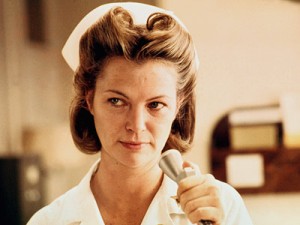
Remember indifferent Nurse Ratched in One Flew Over the Cuckoo's Nest?
Sound familiar? We have heard far too many horror stories of moms like this one; stories of so-called lactation “specialists” who took one look at a vulnerable new mother’s exposed breasts, and shook their heads, non-chalantly crushing that new mother’s hopes and dreams. Giving out nipple shields like they are candy, telling a mom that she will have difficulty breastfeeding because her nipples are too small, too large, or too flat, recommending nighttime formula-feeding so that mom doesn’t “wear herself out,” are just some examples of routine, non-evidence-based — i.e., bad — advice given out daily which can spoil breastfeeding, often for good. To be sure, there are excellent, gifted lactation consultants (IBCLCs) and lactation counselors (CLCs) all over, both hospital-based and in private practice. There are also many wonderful nurses who go above and beyond to help mothers succeed in achieving their breastfeeding goals. Unfortunately, however, the Centers for Disease Control found that most hospitals perform poorly on breastfeeding support. It is a crying shame, but new parents can’t assume that every hospital with a maternity center-some 3,000 in the U.S.-will provide quality breastfeeding help. Unless the institution itself has been designated “Baby-Friendly” (and only 3% are) or has a proven track record of high breastfeeding initiation and continuation rates, you will very likely find an awful lot of lip-service to “breast is best”, and along with it, imposters – nurses dubbed “lactation specialists” who have only received a few hours of uncredentialed breastfeeding education, or who have enhanced their paychecks and credentials by taking the IBCLC test but don’t display competency (or much compassion), and don’t seem to stay true to evidence-based breastfeeding management. And the real lactation “pros?” There are many awesome, talented lactation consultants who are crushed under an impossible caseload and unable to deliver the care they are capable of. And often they are like lone wolves running against a pack of nurses and physicians, and pushing against outdated hospital policies.
The cost of this masquerade is very high, and those who are committed to delivering excellent breastfeeding care have known this for a long time: Relying on poor quality lactation support and having a miserable breastfeeding experience, can be a bigger blow for moms personally, and for breastfeeding in general, than not having received help at all. Moms who go down this road of getting quasi-help and failing will be absolutely convinced that they are fundamentally incapable of breastfeeding, and worse, even that it was their fault. Their collective experiences also validates the common myth that large numbers of moms “can’t” breastfeed or that breastfeeding is always horrendously difficult. Their destroyed confidence can affect how they feel about mothering this child, can carry over to their next newborn, can discourage their peers, and can provoke understandable defensiveness and anger against those who well-meaning friends, health care providers or advocates who harp on about breastfeeding.
So, what is an expecting or new mom to do? We encourage you to educate yourself and to be empowered as you choose where you will deliver your baby, and as you go through the birth and new mother experience. This doesn’t mean that we want you to be a nightmare patient; it is always a good idea to be pleasant and respectful as you advocate for yourself and your babe. We have a great deal of respect and admiration for the thousands of health care professionals whose job is to take care of us when we are at our most vulnerable, and a little courtesy goes a long way. That said, unless moms start asking questions and requesting that hospitals provide truly excellent breastfeeding support, nothing will change.
Here are some suggestions:
- Rely on word of mouth. If you haven’t joined a breastfeeding support group, do so now, and get the skinny on which birth centers and hospitals are best for breastfeeding support. You may be lucky and have a Baby-Friendly Hospital nearby! If you can’t find a breastfeeding group, tap into the doula and midwife community in your area: these professionals are a wealth of information.
- Have a back-up plan: bring the numbers of a few recommended, independent lactation consultants (IBCLCs) or proven excellent lactation counselors (CLCs) with you, even better, interview a few in advance and put the number of the one you are most comfortable with in your speed dial. Again, it’s best to find qualified help by word of mouth through a breastfeeding support group, the birth community, or even a baby store. You can also go to www.ilca.org and search for lactation consultants by zip code.
-
Get to know your lactation consultant.
Heather Kelly, IBCLC, teaches a breastfeeding class in NYC and gives workshops through BigCityMoms.com
Read What to Look for In a Lactation Consultant by Heather Kelly, IBCLC. Interview potential LCs by phone first; do they make housecalls? Do they take your insurance? How are fees structured? Do they run a support group? Most importantly, does their style mesh with your parenting philosophy?
- Know excellence. Quality lactation counselors are highly trained, compassionate, and have your and your baby’s best interest at heart. They are excellent listeners, will take your breastfeeding history, will be professional, and will always ask for permission before examining you or helping you with a breastfeeding position, hand expression, or the like. They want to make sure you have all the information you need to make an informed decision so you can begin the parenting journey with confidence, no matter what your final decision is, whether to breastfeed, formula-feed or a combination of both. (Like a good coach, though, they will want to help bring out your best, and are likely to encourage and motivate you to try breastfeeding for a while before you make a final decision.)
- Watch for red flags: anyone who touches you without asking, judges you, or humiliates you is not acceptable. You may want to take down their name and the details of what happened and consider further action. Hospitals want to serve their patients and will want to know if the quality of their care in any arena is unacceptable. Wait until you’ve caught up on sleep to make sure you have a good perspective.
- Prepare for breastfeeding before birth. Read our Ultimate Breastfeeding Preparation Checklist, learn how to find your A-team (ob-gyn, hospital, pediatrician), read the Learning Curve, and How to Get Your Best Game On, for starters. Pregnancy lasts nine months but the benefits of breastfeeding last a lifetime for you and your babe, babe! Decorating the nursery is fun but knowing how to navigate booby traps is essential.
How does excellent care look from the perspective of a lactation consultant? Not to set the bar impossibly high, but here is the experience of Nikki Lee, RN, IBCLC, a wonderful lactation consultant (and my teacher during my CLC training), taken from her comment on our post about Healthy Children:
I loved my work as a hospital LC. My favorite thing was to invite the baby into the conversation and encourage the mother to put her baby skin to skin, then pull up a chair and sit and chat. Neither the mother nor I could see the baby because it was under a blanket on the mom’s chest.
Half the time, in the middle of our conversation, the mother would get an amazing surprised look on her face and say,”My baby is breastfeeding”. I LOVE THAT!!. No work on her part, we were having a good time together, and the baby showed the mother that breastfeeding could be very easy.
The stuff I didn’t like about the hospital experience was having to fight against the ignorance of some hospital staff who were suspicious of skin to skin and totally convinced that giving the baby a bottle of formula was the solution to most problems and challenges. I didn’t like that mothers and babies were never left alone to figure things out for themselves. I didn’t like the time presssure, that a baby would have to nurse by “X” number of minutes, or else.
I really didn’t like how mothers and babies were injured and disconnected from each other as a result of birth technology and surgery and induction. It was so difficult to get breastfeeding going when a mother was recovering from surgery and her baby was premature.
I also didn’t like that so many staff people wouldn’t want to know anything about breastfeeding even when invited to watch me and learn. They would just wait for me to come to work so that I could take care of all the mothers. Breastfeeding is everyone’s business, not only a LC’s!
Every once in a while, I would encounter a mother that didn’t want my visit. Sometimes it was because she’d nursed a bunch of other babies and felt confident. Sometimes it was because she’d heard bad things about LCs. That was hard to hear.
I loved to see the mothers that had chosen not to breastfeed. I wanted to be sure they knew how to be comfortable with their breasts that would have to dry up. I would sit down and chat with these mothers, and after some conversation, ask how she made her infant feeding decision. Half the time, the reason she’d made her choice was out of some misconception about breastfeeding. When that misconception was corrected, some mothers would change their minds. That was exciting. The other times, where the mothers were absolutely definite about their choice, I would ask them to tell me more so I could learn about their lives and the reasons for their choice. This was important and humbling.
Any strategies you have used to ensure you get excellent lactation care in the hospital or birth setting?















I was planning on delivering at a Baby Friendly hospital, but after an emergency homebirth I was transferred to a closer hospital instead. The lactation consultant there was awful, but luckily I had already surrounded myself with people who could help (such as my Bradley instructor and LLL). I also used kellymom.com a lot and the LLL website.
Next time I plan on doing a homebirth on purpose. I’ll get a midwife who is also a lactation consultant and probably a postpartum doula.
This is an excellent article; so well said. As an IBCLC in provate practice, I have many moms sit down in my office and cry. They felt violated by the lactation consultant in the hospital with the old RAM method of mashing the baby into the breast. When questioned as to why one client waited 6 weeks to seek help- though in terrible pain- she said she had been so traumatized by the lactation consultant that she was afraid to see another one. How many times is this happening but we aren’t told about it? The letters after the RN without real knowledge and supervised learning are far too widespread.
Thanks for not being afraid to speak the truth!
Debbie
Beautifully written! One of the great frustrations that many moms share with me is the conflicting information given by the “experts.” As you say, many of them who don’t meet their breastfeeding goals feel as if they have failed, when the reality is that it is often the system that has failed them. I am passionate about the importance of getting good information about breastfeeding BEFORE baby comes. I visit with OB’s in my area, offer information and support, but rarely is that information passed on to the mother. Frustrating!
My mother is an IBCLC. And I cringe every single time someone tells me that they saw the “lactation person” at the hospital and received lousy advice.
Every woman deserves to have the breastfeeding experience they want — whether it is for 5 days, 5 weeks or 5 years. And it shouldn’t be taken away because the hospital was negligent in hiring qualified, competent IBCLCs. (Who also should be available 24/7. Babies need to eat around the clock and should not be forced to wait for a shift change!)
Thank you recognizing that becoming IBCLC takes a lot of hard work but more than that, it takes a passion. I’ve left home visits that I was referred to because mom got off to a horrible, not-at-all-her-breastfeeding-plan start. I’ve followed up with reassuring phone calls, worried, fretted, hoped, prayed, facebook-friended and twittered, wanting breastfeeding to go as well as mom dreamed of when she was planning for her baby. I’ve caught myself with my mouth open wide hoping that baby’s will do the same when he takes that first “breast sandwich”. Thank you for recognizing that lactation consultants read, study, question and constantly update their skills so they can pass on the most effective way not the “way I’ve always done it”. I was a MCH-RN for 15 years and only now do I really feel entitled to give reliable breastfeeding advice. I love this article!
Excellent article … thanks !
In my 20 years as an IBCLC, several mothers have said to me ” I was so afraid to make an appointment with *another* LC … Is THIS what a consultation is supposed to be like ?” How sad …
We have much work left to do … keep on keeping on.
After a client’s birth a few years ago (I am a doula), I remember being horrified by a bit of “advice” given to this very new mom (who wasn’t even in a postpartum room yet): “Now, make sure you don’t drink too much water, it will dilute your breastmilk.”
Seriously. WOW.
Wouldn’t you think nurses working in obstetrics or postpartum would be required to at least have BASIC lactation training/education?
I was shocked.
This is an interesting article. It makes me feel that my experience is not uncommon.
I also had some awful BF advice in the hospital, including a female doctor who took one look at us and promptly told me that my baby was “not a good nurser”, without offering any help. We also had what seemed like an endless barrage of well-meaning professionals giving us completely contradictory information with little explanation.
I was prepared for a challenge, knowing the experiences of others in my family and having seen them get through 2-3 months of real difficulty before getting to enjoy the next year or so of successfully nursing. Still, my hospital experience racked my initial confidence and easy-going attitude.
Luckily, after leaving, 3 wonderful private lactation counselors (the first recommended by my doctor, and each in turn referring to the next) were my guides in compassionately sorting out what were actual quite real BF problems. After addressing the anatomical issues, and a lot of encouragement and guidance, I can happily say that at 3 months my daughter is a great nurser, and I look forward to the next year or two of her life to enjoy this part of being a Mom.
I hope that hospitals get the message that this is a real problem. New moms shouldn’t need a team of cheerleaders to wade through and survive discouraging and offensive lactation support in the first 2 days of motherhood.
I am proud to be a hospital-based IBCLC. I am constantly finding ways to gather more information. I feel that we are honored to work with new moms, whether the baby latches on well or not. It is our job to troubleshoot and put together a plan of care that the mom is comfortable with. They look to us for current information and skill. I have the best job in the world and I hope that moms can sense that!
How wonderful that you work in a hospital that is smart enough to hire an IBCLC . . . and how lucky the moms that give birth there are to have your help! Kudos!
Thank you for acknowledging the value of the IBCLC’s expertise, both in the hospital setting and in the community. My only concern about this article is that there are a few times when the terms “lactation consultant” and “lactation counselor” are used interchangeably, yet my understanding is that they refer to two different things. When the purpose of the article is to highlight the qualifications of the most experienced of the lactation team, namely the IBCLC, then it seems that only the term “lactation consultant” should be used. The directory listing on ILCA’s website is a listing of lactation consultants who hold the IBCLC qualifications, but I don’t believe it includes a list of lactation counselors, whose qualifications will be different. Once again, I do wish to thank you for your article, and for encouraging parents to check into the resources at their hospital and in their community ahead of time. Sound advice indeed!
Thanks for the correction, you are absolutely right! I have fixed it. Indeed, too often, parents don’t understand that there is a vast difference between “breastfeeding specialist”, “lactation specialist”, “lactation counselor” (which is usually a CLC), or “lactation consultant” (which is an IBCLC).
They just released a report on breastfeeding in Toronto and I was surprised to learn that only one hospital met the criteria for being baby and breastfeeding friendly! I guess that means we have a ways to go.
http://wp.me/pKEBd-4x
Exactly! I truly appreciate the time you’ve taken to clarify. By the way, this website is fantastic and will be a great resource to the new moms and dads whom I serve. Thanks for giving breastfeeding the makeover it deserves. Keep it going!
great article! The LC on-call at the hospital where I gave birth showed up for all of 3 minutes while my son was asleep on my chest. She told us to call her when he woke up and she’d come by to offer help and answer questions. A little while later he woke up and we called her. She didn’t answer and we never saw her again before we were discharged. She was absolutely useless for us. I don’t blame her though, I blame the hospital for not spending the money to have enough LCs on staff to help. My son had a terribly shallow latch and I was at my wits end when another LC met with me and saved our breastfeeding relationship.
I had a horrible experience with a hospital lactation consultant. At 12 hours postpartum, she basically told me that my baby would never latch because I had flat nipples and her bedside manners were horrific. Thankfully, I was committed to breastfeeding and I had an amazing network of online friends that helped me. I also found an amazing IBCLC in private practice. It took my baby over four weeks to latch consistently, but she went on to nurse for two years.
Thank you for sharing this information!
As a LLL leader, I’ve heard a million bad LC stories. The worst is when a mom comes to LLL looking for help she couldn’t get from a “qualified lactation consultant”. Our county hospital has earned the Baby Friendly label but has also required all the RN’s on Labor and Delivery and Postpartum to take the IBCLC course. When you send a nurse to a class by threatening to take her job, do you really think she learns and treats her patients accordingly?
Thank you also for recognizing CLCs who are an important part of the breastfeeding professional world.
Not everyone can or wants to spend the time in a clinical/hospital setting (as is necessary to become an IBCLC) to learn how to effectively help women breastfeed. As one who is a lactation educator and who will go through Nikki Lee’s CLC course this spring (and who is also studying to become a CPM to midwife at home births), I think it’s important to let moms know there are several types of lactation professionals from whom they can seek reliable advice.
IBCLCs and CLCs both work passionately to help women & babies!
I’ve had these horrible experinces. Nurse in hospital grabbing me and pushing baby’s face into me and walking out of the room. By no less than 3 people because I was having trouble. I won’t go into the drama that ensued for the follwing two weeks. But I have met a REAL LC who is amazing. If anyone in the Metro Detroit area needs one, I have an AMAZING referral! Great article, gives hope to the parents out there that have had the bad experience.
Love this article! I wrote on my blog today about the wrongheaded “help” I received from hospital LCs - they gave me a small nipple shield that caused severe damage, when I didn’t need a shield in the first place! And had me pumping starting on day 2 of my son’s life. And then I saw an absolutely wonderful private practice IBCLC who totally saved my sanity and my BFing experience. HUGE difference.
While I highly value the experience and qualifications of an IBCLC, and am saddened by the amount of bad advice given by others who pass themselves off as equally qualified, I had a FANTASTIC experience with my hospital CLC. It bothers me when talking to other lactivists when she’s brushed off before even hearing about her because non-IBCLC lactation specialists can be so hit and miss. Some of them really are great!
6 weeks in my daughter and I STILL had horrible latch issues, I was breastfeeding then pumping and then feeding her only pumped breast milk. I was exhausted. Since there is absolutely no one in my area to get breastfeeding support or advice (I am the ONLY person I knew at the time who breastfed). I went back to the hospital the LC to discuss with her my options. She told me quote un quote “You have tried hard enough, and you are causing your baby to suffer because you refuse to buy her formula. If you don’t want to spend the money on your child to get her milk, I will give you the fifteen bucks myself.”
Worst day ever. I said a few things I shouldn’t say online, walked out of the door and left.
My daughter is six months old, we got through our latch issues together (with the help of kellymom) and we are still at 100% breast milk and just introducing solids. And I NEVER bought that can of formula.
Nice article…I have been a maternal-child nurse since the 70’s and it is sad that there are still so many stories about poor lactation support in the hospitals. It should not be that way. I am wondering why this is so? The mother-baby staff should be supportive of the breastfeeding dyad as well as those who choose to formula feed.
Why do you think there are still hospitals that are not breastfeeding friendly?
Wow! I loved my hospital’s ibclc. Big shout out to the wonderful Bridgette in Simi Valley,CA. She was there, magically, at my 3am c-section, and helped with our first meal - a 20min GBF. I’ll never forget … And her weekly free support group meetings were the highlight of my mat leave. I knew we had a gem but reading some of these stories, I see just how blessed we are to have her. Happy IBCLC day to you and to all the loving women (and men too I wonder?) who serve in this most challenging but necessary occupation!
Well I have a horrible experience in an area where we ONLY have two, one is never available and the other shot down my hopes to fully breastfeed with her own opinion in a way that led me to stop pumping. I had so many issues breastfeeding, my son was not gaining and now I have a girl, I am left unable to call anyone, there is no support I am all alone. But this time I will not rely on anyone, I know there is no one I can count on! I wish I was nearer to competent encouraging IBLC’s.
My heart breaks for you that you had such a difficult experience and that you got so little help! But you are NOT alone! Many women have developed an online network of support-through Facebook (The Leaky Boob, Kellymom.com, BestforBabes) and through websites, parenting forums etc. You might also check if there is a Holistic Moms Network chapter in your area, and/or a La Leche League group. Good luck with it and we are cheering you on!
I have been an LC since the late 70s. As a professional I hate hearing about moms having poor experiences based on poor information and interaction. Yes some hospital LCs are poorly prepared but this is the fault of the hospital not the LC. Others are well trained and experienced working in evidence based programs. In the community there are outstanding LCs and very poor LCs. Many physican’s offices utilize nurses and put a lable on them, having sent them to a conference. Very often private and physician office LCs work in a vacuum sealing in the old information or arbitrarily combining information to make it what they want. Others walk well out of their scope of practice. We also need to be careful about judgement. Mothers grieving for the loss of an ideal experience or a complete experience may not remember clearly or displace blame to cope. I suggest instead of these awful, judgemental statements we work to license LCs and find ways to help others grow. Turning on ourselves and “eating our professional own” will not get the job done. remember any of us could be the focus of a complaint. Let’s pull together to make our professionals as good as they can be.
We absolutely need to license LCs and help them grow. But unless we let mothers know that all lactation specialists are not equal, they will continue to blame themselves for “not being able to breastfeed”, and continue to perpetuate the myth that breastfeeding is too difficult. Hospitals and physician’s offices won’t be motivated to hire and properly train LCs until moms demand it, and moms won’t demand it until they know the difference between good help and inadequate help! We should “eat our professional own”, but we shouldn’t protect a system that allows for substandard care, either.
Thank you, Whitney! Working as a hospital based rn lc (ibclc) for the past 13 years I’ve come to realize that #1 moms are likely to say different things to different people; and # 2- babies behavior can change dramatically from one day to the next and what the lc sees after discharge can be totally different than what the lc in the hospital had to deal with. I try to assume that everyone is doing the best they can at the time with the resources they have. Unless hospitals are willing to pay fairly (!) for lactation consultants, we will always be fighting the battle of under-qualified breastfeeding helpers.
This article validates my experience with the lactation consultants/nurses at the hospital and then in a clinic after I brought my son home. It was horrible, to be honest, and led to me becoming an “exclusive pumper” (5 months and counting!)! The LC in the hospital wasn’t available until 24 hours after my baby was born, so I had random nurses mashing my baby into my boob for the first 24. He didn’t latch well, and though he was born 9 days late, I was asked by several nurses (in a patronizing tone), “is he a premie or something?” The LC told me that she wasn’t surprised he couldn’t latch because I am fair-skinned and therefore have super-flat nipples. Out came the SNS and nipple shields. I went home, feeling like a miserable failure of a first-time mom because I couldn’t even get my newborn to eat from the breast! I sought the help of a clinic-based LC. She again mashed my son onto my breast, declared him “lazy,” told me to buy a more expensive pump and gave me another nipple shield. After 6 weeks of a crying, hungry baby and a crying, frazzled me, I switched to exclusively pumping and formula supplementation and found relative peace. This experience definitely colored my experience for the next go round. I’ll try breastfeeding with the next little one that blesses my life, but will definitely find better support!
I’ve wanted to write to my hospital lactation consultant and suggest that she call herself a feeding consultant instead. On day 2 she told me my son dropped too much weight (9% and I had been pitocin and fluids for 2 days!) and that I obviously didn’t have enough milk and if I didn’t start supplementing right away then he would languish and die! This is a very true story, she scared the crap out of me and never gave my body a chance to establish a supply before undermining it, thus ensuring that I would HAVE to continue to supplement. I DO need to write a letter, if for no other reason than closure. In spite of PPD following this and powering thru nursing across many other challenges (difficulty latching, inverted nipple etc.) we persevered, stopped supplementing at 11½ months and are still nursing at almost 17 months I wish I had sought help outside the hospital and work in a field that exposed me to enough info to not trust a hospital LC. Live and learn.
I wouldn’t even call her a feeding consultant- I’d call her a booby trap! Please do write a letter, unless hospitals hear from us they won’t change. Kudos to you for persevering!
She is most definitely not a feeding consultant. A feeding consultant would be a person who can give good, accurate information and guidance on all aspects of infant and toddler feeding (nursing, pumping, bottle feeding, proper use of formula, introducing solids and table foods, weaning, etc.). Many lactation consultants should be called feeding consultants — but in a good way! I agree with Bettina that she should call herself a booby trap.
The night after my son was born, I made the mistake of sending him down to the nursery after feeding him so my husband and I could get a little sleep (neither of us could sleep with him in the room because we were too afraid that something might happen and we wouldn’t wake up). I instructed the nurse to bring him back when he woke up so I could nurse him. It was about 2 in the morning, I had been asleep for maybe an hour or two, and I was awakened to the nurse bringing my screaming son into the room. We were using a nipple shield because he couldn’t latch without it, so while I proceeded to blindly (didn’t have my glasses on and the room was nearly dark) fumble with the shield and try to latch a screaming baby who kept pulling the shield off with his hands, the nurse started playing 20 questions. How is your pain? Are you have any increase in discharge? How often do you need to change your pad? Have you been drinking water? When was the last time you used the bathroom?
Mistake number two, I should have followed my instinct and yelled at the nurse to shut up. Instead I took my frustration out on the nipple shield and threw it down on the bed and swore at it (I then picked it right back up and tried again and finally got my son latched after a couple more tries). Well, that little outburst made its way into my chart, and at every shift change the next day, the nurses would say, sympathetically, “oh, I see nursing was a little frustrating for you last night.” Yes, my son and I were having trouble with nursing, but my real frustration was with the nurse.
Thank you so much for this wonderfully written piece. Just yesterday, a disappointing article was posted via Facebook by Kellymom, by someone who basically discredited anyone OTHER than an IBCLC. I am a CLC, and you will not find anyone in my community as passionate and dedicated to helping nursing mothers as myself. What people don’t realize is what can be going on behind the scenes - I am working at my OB/GYNs office as their Lactation Counselor, I am enrolled in a 200 hour Lactation Consultant in training program, and will sit for my IBCLC exam next year, but that cannot be done without clinical hours, so everyone has to start somewhere! It would be like having faith in a teacher to tutor my children, who is JUST about to graduate college after being in a wonderful teaching program, where they have just learned the most current methods and protocols in the world of education, has had hours of student teaching, and is committed to doing anything possible to help my child learn… but they just don’t have their diploma yet.
My hospital’s IBCLC just retired, and during an interview, I was able to prove to them my competencies as a CLC, as well as show them my dedication, knowledge, and commitment to furthering my education in the field of lactation. So, to some, I am just a CLC… but in reality, I am a mother with experience, a lactation counselor gaining clinical hours to sit for my IBCLC, and a counselor who in the meantime, has helped MANY women reach a point in their breastfeeding journey that they would not have reached, had they not reached out for help. I am a FIRM believer in the Healthy Children’s CLC program, and credit them for giving me the skills necessary to combine with experience and other lactation education to help land my position at my hospital. I hope to make the Healthy Children’s Program and CLCs everywhere proud!
Congrats on your work in lactation and the fact that you work in an OB/GYN office! Those new moms really need you (and we need you as an IBCLC! Good luck.
Betsy IBCLC
I honestly don’t feel that my “lactation consultant” was a good one. I definitely felt embarrassed. She didn’t listen when we discussed beginning with my son (who was born premature, so he was roughly 21 weeks gestation at the time, and not really developed with a suck reflex). Partly because of this and later experiences with her, including abruptly giving up when we were trying, and an apparent lack of patience, resulted in my son being bottle fed, and my pumping, for just over 9 months. My preemie baby had enough challenges - I wish I could have at least given him that.
I really like this article, Thank you. I felt like I was never a priority to the hospital lactation staff with my first daughter. She was asleep when they stopped by my room, so the LC asked how it was going. When I said I wasn’t sure, she handed me a bad copy of a simple handout saying that I should try to imitate the pictures when I get the baby to latch. I could barely see the pictures on the page, and thought I was doing things right because the nurse said it looked fine even though I knew it wasn’t supposed to hurt. (My mom completely disagreed with that fact though, because with all 8 of the babies she nursed, it hurt for the first few weeks. She’s one of those who suggests “roughing up” your nipples by using a loofa in the shower before the baby comes.) At 5 days old my newborn was admitted to the hospital for dehydration. I went to a helpful lactation consultant, but couldn’t get my daughter to latch on my own. The same un-helpful LC came to see me at the hospital again and asked me to lift my shirt, then made comments about how widely spaced my breasts were (after measuring with her fingers), didn’t explain why, and said I may have low-milk supply. I had a helpful LC with my third, but still had issues. (Thankfully I was able to nurse with an at breast supplementor, and had my own kind of success with that child.) Apparently there my problems are able to be fixed easily. I’m excited to be developing strategies for my fourth child due in August. So thankful for a good midwife, and that this time I’ll be ready for the challenges instead of just educating myself and hoping for the best. It’s important to know that there are real challenges out there, even if most can be solved with a little help. I assumed my problems were simple and things would have worked out if I had just been able to latch right the first time.
I think that sometimes we moms think we should be able to make it work ourselves and expect to just be told the same thing again if we call for help.
I felt set up for failure when my baby did latch but not correctly in the hospital . I requested a lac consultant who didn’t come til the day we were discharged . She quickly told me the baby was latching and left . Well she was latching , but not correctly . As a first time mom I felt confused. I had a lot of nipple damage at first and incredible pain with every latch . I was determined to read and research and figured it out . But I would have loved more help at first .
We are happily still Breastfeeding and have been for almost 5 months now !
I love the *idea* of baby friendly hospitals, but implementation is a whole nother kettle of fish.
I had a horror movie birth with my third child, and the Karla Homolka nurse was the one to come in and order to breastfeed my child, now.
I explained that he had just nursed on both sides, for a total of thirty minutes, that this was my third child (she had never given birth), and that he was happy, full and asleep. I also mentioned that i was still nursing his two year old big sister, and already had plenty of milk alread, just hours after birth.
But that wasn’t the point. Control and humiliation was. Eventually i pulled out the boob and tried to get my hours old, sleepy little man to take another suck, after which she refused to believe me that he had pooped. She could have just looked in the dirty diaper in the container attached to his isolette.
I signed us both out AMA and called my husband. If he wasn’t coming to get us, i was ready to start walking home.
Sounds like you definitely had an imposter, and did not give birth in a BFHI facility that had been designated “Baby-Friendly” by http://www.babyfriendlyusa.org. What an awful experience!!
I was lucky to have a great (not perfect) LC at the Lactation office at my hospital. My twins we’re electively deliver by cesarian at 37 wks. My son 7 lbs was taken to a warm and soon after to the nursery then NICU for respitory immaturity. My daughter 6 lbs 3 oz was taken to the nursery while I laid in recovery. I wish I had been stronger, I wish I had demanded. I wanted my babies STS in the OR but the doctors told me no long before even going to the hospital. I wonder if we’d had the STS time, would my son have spent his first 2 days in an isolet on formula and later on a CPAP, his weight fluctuating and his latch terrible, tongue on the roof of his mouth. My daughter did not have any breathing issues and spent no time in the NICU but was tired and didn’t have the energy to suck, when she did latch on it would only last a few minutes and she would fall asleep. One LC who visited at the hospital, helped me spoon feed precious colostrum to my baby girl. After discharge from the hospital, I had a strict schedule on finger feeding with a tiny tube to keep her weight up. I pumped ever chance I could even if nothing came out, most going to my daughter and the rest to my son. I rationalized it as - she had never had formula, he already had been fed formula in the NICU without my permission, I truly do not remember anyone giving me the opportunity to nurse him during his first 2 days. Nursing/pumping for him in he NICU was difficult but I gave him all the milk I could. My daughter came home at 4 days old with me, my son came home 4 days later. At home I continued finger feed my daughter and nurse-train/pump/formula feed my son. Multiple trips to the LC saved my sanity. She and I worked out a manageable schedule and carefully tracked the growth and feelings of both babies. Certainly in all of this, my husband was my rock, but she was the grassy tuft that cradled me and my fear of failing. She gave me encouragement and reassurance that my instincts were spot on and she helped to hush all the voices around me that only said I couldn’t do it, that it wasn’t worth it, that they wouldn’t thrive (including the pediatrician who told me to put my son on higher calorie formula because he wasn’t gaining fast enough for her). My babies were born 10/13 and on 12/9 I was awake at 4 in the morning, trying to juggle two screaming babies, a breast, a bottle, formula and weeks of stress. I decided enough is enough!!!!! I decided right then that I would and could exclusively breast feed both babies. It took a week for my milk production to adjust to my new demands but I DID IT!!!! I fed my beautiful babies exclusively from 12/9/10 until 11/22/11. I still wish I had made it a full calendar year of EBF. I had a severe gallbladder attack and stopped because of the pain killers I was taking. I wish I had started BFing again after my surgery.
I still wish a lot of things, but if not for that one special LC, I wouldn’t have come as far as I did.
Sorry for any and all typos, I was typing thru tears on my cell and missed a few errors.
Oh I also forgot to add my favorite and proudest moment thru the entire ordeal with the pediatrician. When we returned for the next check up, she was so excited to see that the twins had each gained almost 2 pounds she said ” this is wonderful! How much formula are they getting?” and I said, ” I never did start her on the formula, and I stopped his formula completely 3 weeks ago. They are both 100% breasted now”. It took a few moments for her to pick her jaw up off the floor. LOL
I wish that more moms could read your story and be inspired! You are amazing!
One of the issues I feel caused your problems was delivering (electively) your babies at 37 weeks. That gestational age is still “late pre-term” and these babies more often than not DO have feeding difficulties (and are sleepy as you describe). I am glad your story has a happy ending and that your twins were great breastfeeders in the end. As an IBCLC, I know how difficult the feeding issues can be with these babies because at 37 weeks, they really are NOT ready to be born and feed well.Best of luck as your babies grow!
I am an IBCLC at a Baby Friendly hospital and I am so glad my presemt facility requires ALL nurses to take a 24 hour online breastfeeding course as part of their basic training. That basic education helps so much . There are still times when I cringe at what I hear a patient tell me the nurse told them regarding breastfeeding, but it is so much better than where I worked previously.
What online training course did the nurses take? We’d love to spread the word about it! Thanks for your comment.
Thank you for this post! There are amazing lactation consultants and counselors. But there are also IBCLC, in specifically in hospitals, that at least here locally give mothers terrible breastfeeding advice and often times ruin their chances of successfully breastfeeding even before the baby is 2 weeks old. We see it often at my store where mothers come in crying because the hospital IBCLC (I’ve double checked and they are nurses that are IBCLCs) have pretty much told them they can’t produce milk and so they should just give up, or that (this one just yesterday) she should supplement or else she’ll be nursing 24 hours a day and more. It’s really important for mothers to know how to choose their lactation support and who to reach out to. If unsure who to see/where to go, contact your local LLL group leader and ask her for a recommendation.
This was an incredible post! I will say though, passion for lactation, compassion for the new mom, and staying to date are critical regardless of one’s qualifications. I am a CLC and had the privilege of training under Karin Cadwell after working with breastfeeding moms at a huge OB/GYN practice for years. I now teach breastfeeding classes and lead new moms support groups for a large hospital system that is on the journey to becoming baby friendly. So far none of our floor nurses are have any significant breastfeeding training - I wish they would do the CLC training! Each of the hospitals are in different stages of adopting BF and boy do some of the hospitals have a long way to go! Every year I observe the IBCLCs on the floor and meet with them occasionally throughout the year so we can understand what the other is providing for our patients and try to unify the message. One of the hospitals is horrifying! Every time I’m there I see and hear things I cannot believe and am so shocked by what they consider a “consult”! The IBCLCs give out of date/bad advice, zero encouragement, misinformation, man-handle the mom’s breasts without even introducing themselves, and shove the baby on while the mom is freaking out that they are so rough with their baby! One IBCLC told multiple patients with engorgement, “sorry, but it’s going to get worse and there is nothing I or you can do to help, you’ll probably get an infection”! Another said, “That baby is a bad, lazy nurser. Good luck to you”! And the one I’ll never forget, said to a mom who’s one day old baby was nursing away with a great latch “your baby looks yellow. I’m getting a bottle of formula, clearly you don’t have enough milk”! Yikes! They dispense nipple shields like candy, have probably 80% pumping on day one, and over half of them have such strong accents/poor English (I live in a very diverse area) that the patients cannot understand them! I find myself having to “translate” and going back to the room to give tips and encourage them to come to the new mom’s group for help and let them know that I’ll be there! At some of the other hospitals the entire lactation team is just as fabulous as Nicki Lee sounds. Sadly the “bad” hospital has an internship program to people trying to for their IBCLC certification. Hence the reason, I’m not interested in going for it right now. The moms and babies who deliver at the “bad” hospital make my job hard! I prepare them, the IBCLCs at the hospital terrify them, steal their confidence, and leave them sliding down a slippery slope, then I get them back once they are discharged to try and repair the damage - if they haven’t given up already!
Pingback: Good Cop, Bad Cop- On the Breastfeeding Police | The Leaky B@@b